
Preparation of the dataset for the tidal analysis requires filtering to remove the effects of changes in the cruising speed. The data set is too large to inspect every time series in detail. A practical solution is to first carry out a rough filtering to remove obvious outliers and passages that are clearly not consistent with the basic assumptions of the analysis. The type of filtering depends on whether the along- or cross-lane currents are to be assessed. Then a first tidal analysis, as described in Approach, is carried out and for each passage the standard deviation of the difference between the AIS and the tidal analysis values is computed. Passages with a standard deviation larger than twice the median value of the whole set are removed.
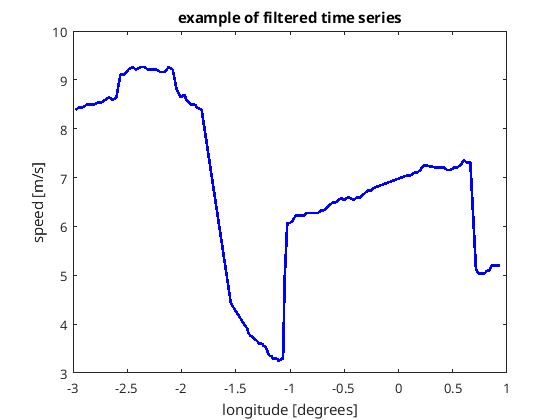
For the analysis of along-lane currents the basic assumption is that during a passage the cruising speed remains constant, so that speed variations are caused by variations in the surface currents. Figure 2 shows an example of a passage where this is clearly not the case. Passages that contain accelerations or decelerations, calculated as the derivative of a smoothed speed time series, larger than a threshold value are filtered out. Some ships use a cruise control system, keeping their speed over ground constant. These passages are eliminated if the standard deviation of tidal corrected speed is larger than of the uncorrected speed. The effects of extreme wind and wave conditions are treated as noise and filtered out in the second round.
After these filtering operations the data set for the west-east lane contains more than 443,000 data points in 5573 separate time series (passages) and the east-west lane has more than 386,000 data points in 5190 time series.
Cross-lane currents are calculated with the help of the cross-current equation (see Approach). Applied to AIS data it turns out that heading values are generally not given relative to true north, as the course over ground values are, but have an offset that varies per passage. As a first regularization the offsets are estimated such that the median value of heading minus course over ground is zero for each passage. These offsets were then updated using a tidal fit of the AIS data.
For a tidal analysis time series with calculated cross-currents for each position of a model grid point and a least squares fit was applied yielding tidal constants of the six most relevant tidal constituents and best-fit values for the currents. For comparison, the same was done for CMEMS cross-current model data.
For the assessment of persistent or slowly varying currents both speed (along) and course (cross) data were used. For the analysis of speed data the part between longitudes -1 and -0.5 degrees was selected for each passage and tidal currents were subtracted. Passages with large speed variations were removed and from the remaining ones a time series was created as median detided speed as a function of the median time. Values from the west-east and east-west lanes were interpolated on a common time grid, smoothed, subtracted and divided by two.
For the analysis of cross-passages the cross-currents were determined between latitudes 50 and 50.3 degrees for each shuttle passage. Tidal currents were subtracted and a time series was constructed of median detided cross-current as a function of the median time. This time series was smoothed to remove noise effects.
Next: Approach.